The House That Hummed
The fog arrived in Brindle Hill at exactly the same moment as Nell Brightwater, and for a long time afterwards she wondered whether it had been waiting for her.
It had been a bright, ordinary afternoon on the train. Fields slid past in neat green squares. A man across the aisle did a crossword and sighed at it. Nell's mother had written the name of the station on a luggage label and tied it to the handle of Nell's suitcase, as though Nell were a parcel, which was more or less how she felt.
Great-Aunt Orla will meet you, the note in her pocket said. Be polite. It's only for the summer.
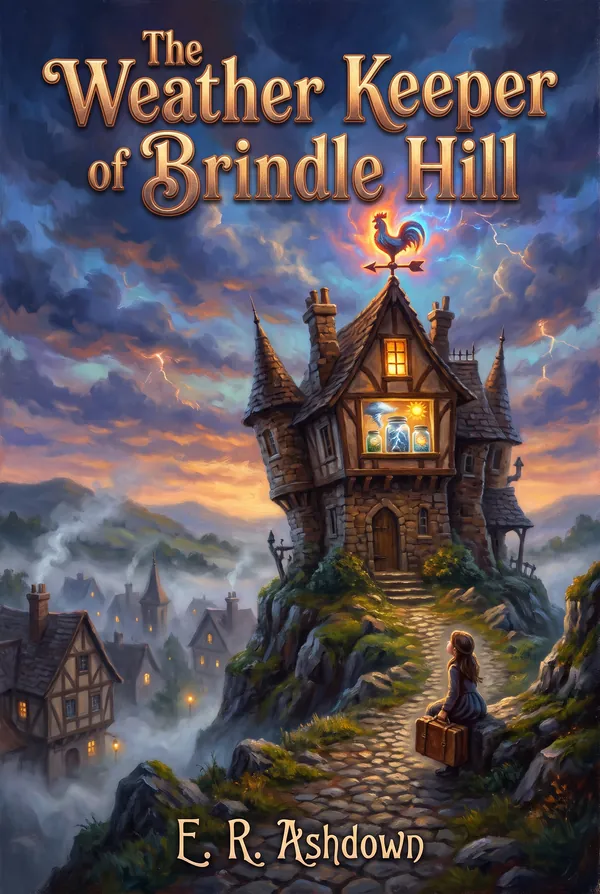
Nell had never met Great-Aunt Orla. She had seen one photograph of her, taken a long time ago: a tall woman in a long coat standing beside a crooked house, squinting at the sky as if the sky owed her money.
The train slowed. A sign swung past, BRINDLE HILL, painted in white letters that had mostly peeled away. Nell stepped down onto the platform with her suitcase.
And the fog rolled in.
It didn't drift in the way fog usually does, softly, from somewhere far off. It came all at once, like a curtain being drawn. One moment Nell could see the little station building, the ticket window, a bench with a sleeping dog under it. The next there was nothing but white, thick and cool and silent, pressing against her face.
Behind her, the train gave a polite whistle and pulled away, and the sound of it vanished almost instantly, as though the fog had swallowed it.
“Hello?” said Nell.
Her voice came back to her flat and small. She couldn't see her own shoes.
Then, out of the white, a lantern appeared. It bobbed toward her at about the height of a tall person's hand, and behind it a shape assembled itself: a long coat, a long face, a cloud of grey hair pinned up with what looked like a pencil.
“You're early,” said the shape.
“The train was on time,” said Nell.
“I meant the fog.” The woman lifted the lantern and looked at Nell for a long, steady moment. Her eyes were very pale, the grey of a sky that hasn't made up its mind. “It isn't due until Thursday. You must have brought it with you.”
Nell didn't know what to say to that, so she said, “Are you Great-Aunt Orla?”
“I am Orla Brightwater,” said the woman, “and you may leave off the Great and the Aunt, or we'll be here all day. Come along. Mind the puddles. They're deeper than they look.”
Nell picked up her suitcase and followed the lantern.
They walked for what felt like a long time. The fog parted just enough to show the next few steps, a cobbled lane going steeply uphill, a garden wall furred with moss, the corner of a shop window with jars of sweets in it. Once, a cat crossed in front of them and stopped to stare at Orla, and Orla nodded to it, and the cat nodded back. Nell was almost sure she saw that.
“Does it get foggy here a lot?” Nell asked.
“As often as it's told to,” said Orla.
“Told to by who?”
“By whom,” said Orla, and did not answer.
The lane grew steeper. Nell's arms began to ache from the suitcase. Then the cobbles ended, and the path became earth and stone, winding up the side of a hill, and at the top of it, rising out of the fog like a ship out of the sea, stood the house.
It was exactly the house from the photograph, only more so. It was tall and thin and made of grey stone, and it leaned very slightly to the left, as though listening to something. There were too many chimneys. There was a round window right at the top, under the point of the roof. And on the very top of the roof, turning slowly, was a weathervane in the shape of a running hare, made of old green copper.
Nell looked at it, and frowned.
The fog was moving. She could feel it on her cheek: a damp breeze, drifting gently from the left. But the copper hare on the roof was turning the other way. It turned steadily, deliberately, against the wind, until its nose pointed straight down into the valley.
And as it did, the fog began to thin.
It drained away down the hillside like water out of a bath. In less than a minute Nell could see the whole of Brindle Hill spread out below her: the crooked rooftops, the church spire, the green and gold patchwork of fields, the silver thread of the river. The evening sun came out, low and orange, and lit the windows of the house so they blazed.
Nell turned to Orla with her mouth open.
Orla was looking at the weathervane with an expression of mild disapproval, the way someone might look at a dog that has jumped up on the furniture.
“Showing off,” she muttered. Then, to Nell: “Supper's at seven. Your room's on the second floor, the blue door. You may go anywhere in the house you like.” She paused, with her hand on the front door. “Except the attic.”
“What's in the attic?” said Nell, before she could stop herself.
Orla gave her another of those long grey looks.
“Weather,” she said, and went inside.
That night, Nell lay in a narrow bed under a sloping ceiling and couldn't sleep. The house made noises. All old houses do, her mother said: pipes knocking, boards creaking, the wind in the chimney. But these weren't those noises.
The house was humming.
It was very faint, so faint she thought at first she was imagining it. A low, warm sound, like a bee in a jar, or someone singing with their mouth closed, far away. It seemed to come from everywhere at once. From the walls. From the floor. From the ceiling above her head.
Nell lay very still and listened.
Under the humming, so quietly she almost missed it, came another sound. A long, low, rolling grumble, that started somewhere above her and rumbled slowly across the ceiling from one side to the other, and faded away.
Nell knew that sound. Everyone knows that sound.
It was thunder.
But the window beside her bed showed a clear black sky full of stars, and not a single cloud.
Nell sat up. She looked at the ceiling. Above it, she knew, was only one more room.
The attic.
Somewhere up there, very softly, something went pop, like a cork coming out of a bottle. And a thin, cold breath of air, smelling of rain, slid under her door and across the floor and touched her bare toes.
Nell pulled the blanket up to her chin, and lay awake until morning, listening to the house hum.